The proof ladder
Three levels of proof, strongest first.
Each clock-in uses the strongest proof available at that door, and steps down gracefully instead of blocking care.
The tag tap
A ten-cent NFC sticker at the client's home is the strongest proof there is: the phone physically touched the tag registered to this client. A verified tap stands in for the distance check entirely, and a tap on the wrong client's tag is refused outright.
GPS with a real fence
Location is captured at the moment of the punch, and with the geofence switched on, a clock-in beyond your radius is refused with the measured distance shown: "You are 800 m from the client's address." The radius is yours to set, per agency.
Care first, always
A dead battery, a denied permission, or a client without a map pin never blocks care. The clock-in goes through, the visit routes to coordinator review instead of verifying itself, and nothing is silently trusted.
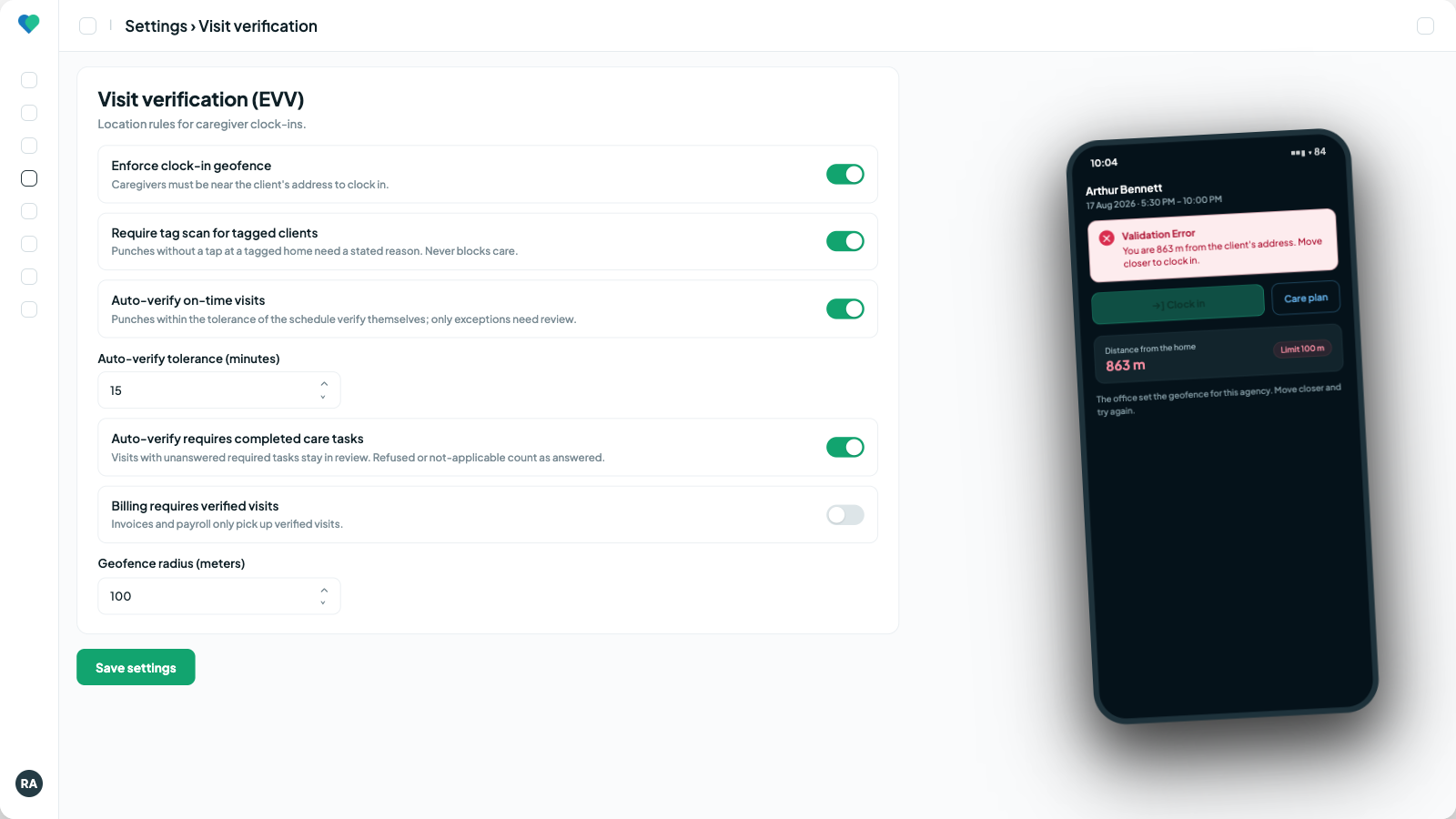
The fence at work: geofence on with a 100 m radius, and a clock-in attempted from 800 m away refused with the distance shown. Click to enlarge.
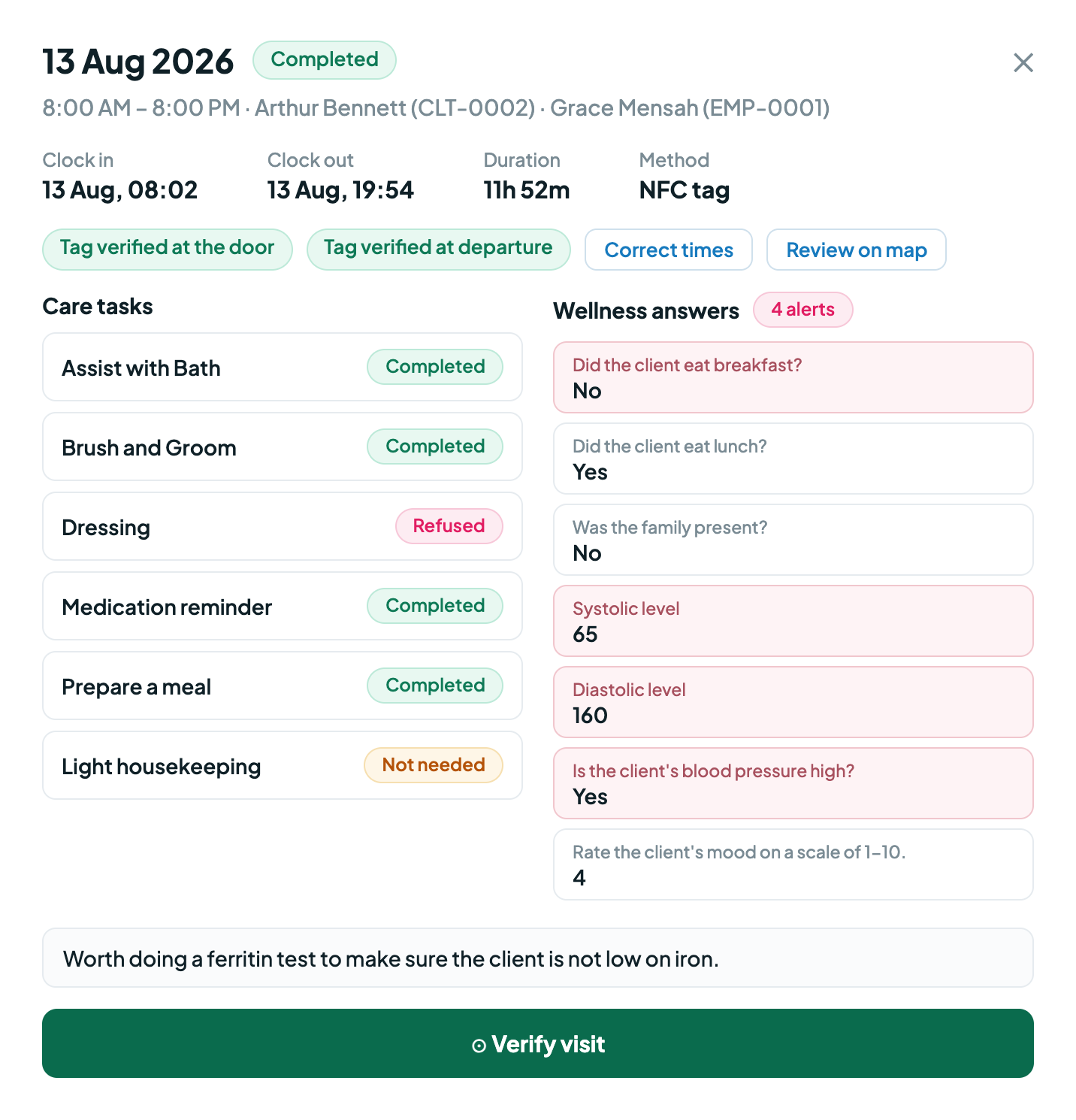
Every visit carries its distances, its method, and a proof badge. Click to enlarge.
Coordinator review
The ambiguous ones take one look.
Every visit carries its punch-to-client distance with a green, amber, or red proof badge, and a map dialog shows the client pin, the punch markers, and the geofence circle together, so adjudicating an odd-looking visit is a look at a map, not an interrogation.
- Punch corrections are permission-gated, require a stated reason, and store who corrected and when.
- A stuck visit gets a manual clock-out with a note; a missed shift can be recorded in full, with the same audit trail.
- Raw punches are never edited. Corrections happen at the visit level, and the original record stays.
Auto-verification
On-time visits verify themselves.
Visits whose punches land within your tolerance of the schedule verify themselves every hour. Coordinators work a Verified filter that shows only the exceptions, and skipped tag taps always stay in the human queue, even when the punches were on time.
The optional billing gate closes the loop: with it on, invoices and payroll pick up only verified work. Generating an invoice over a period with unverified visits warns on the spot, and one click jumps to the pre-filtered review list before any money moves. A dashboard tile counts visits awaiting review, so the queue finds the coordinator, not the other way around.
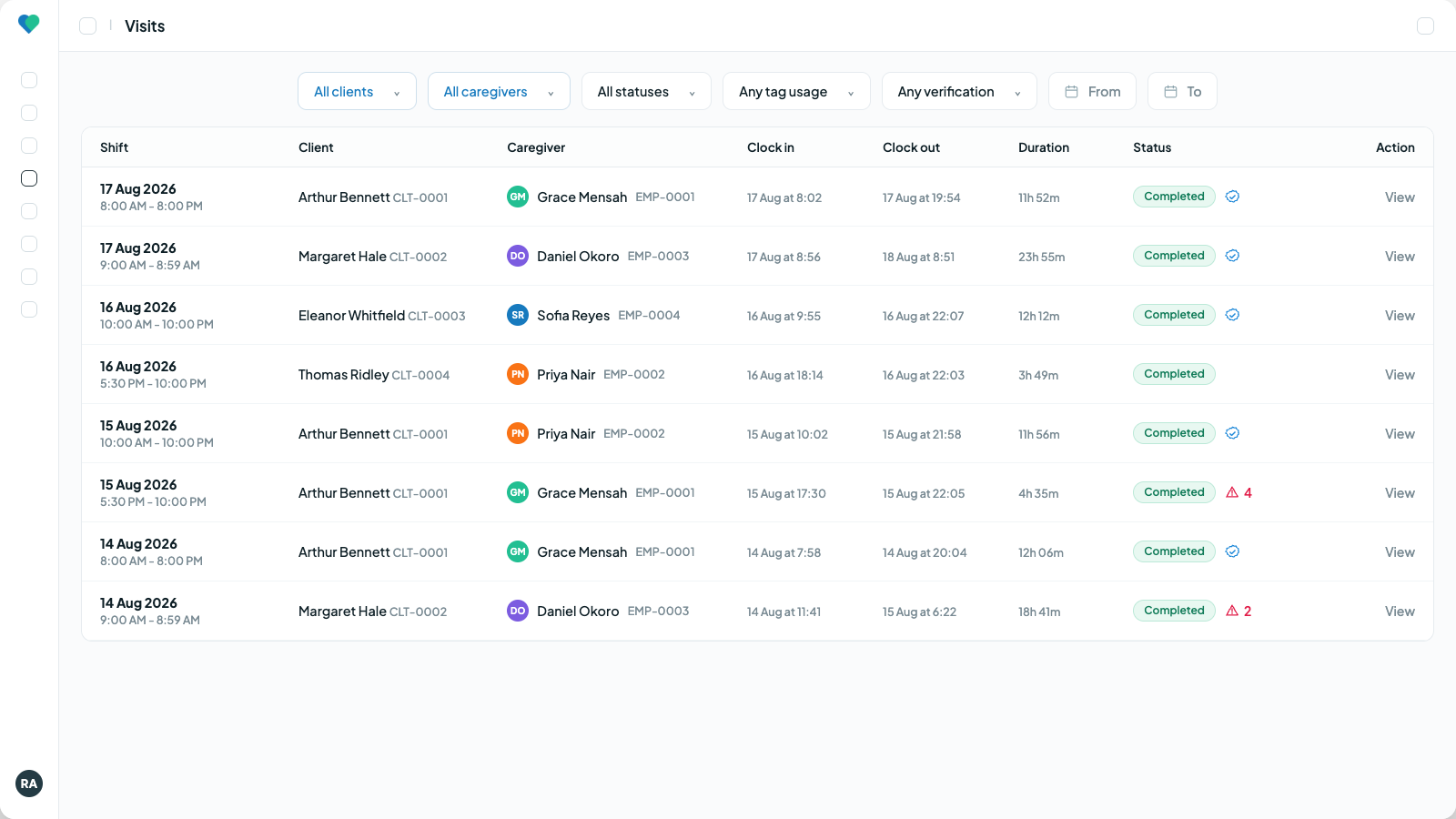
The review queue: only the exceptions, already filtered. Click to enlarge.
Guard rails
Small rules that keep hours honest.
The clock-in window
Caregivers can clock in only from a set number of minutes before the shift starts. The button itself stays locked, reading "Clock-in opens at 8:00 AM", and the server enforces the same rule regardless. Early punches stop padding hours; late clock-ins are never blocked.
Departure proof
Clock-out offers the same voluntary tag tap as clock-in, recorded as its own proof badge. The classic clock-out-from-the-car-park gap closes at both ends of the visit.
Care documented, not just timed
Each visit carries its care-plan checklist, with task names snapshotted so later changes never corrupt past records. An optional switch holds visits in review until required tasks are answered, and wellness answers flag themselves when thresholds are breached.
Offline-safe punches
Every punch carries its own identity, so a retry after a dead spot can never duplicate a visit. Punches sync when the connection returns, with nothing lost and nothing doubled.
Common EVV questions.
Care comes first: the clock-in goes through and the visit routes to coordinator review instead of verifying itself. Nothing is silently trusted, and nobody is blocked from starting care.
Yes. A verified tap proves the phone touched the tag registered to that client's home, which is stronger proof than any distance measurement, so the geofence stands down. A tap on the wrong client's tag is refused outright.
Yes. Permission-gated coordinators can correct visit times or record a full visit for a missed shift. Every correction requires a stated reason and stores who made it and when, so billing always runs on accurate, auditable hours.
Visits whose punches land within your tolerance of the schedule verify themselves every hour, so coordinators review only the exceptions. Skipped tag taps always stay in the human queue, and an optional switch makes invoices and payroll pick up only verified work.
See your first visit verify itself.
Start your 30-day free trialNo credit card to start · Teams without smartphones? See the attendance kiosk