Reporting
Six types, one honest record.
Falls, injuries, medication errors, complaints, property, behaviour: each incident is logged with a severity from minor to critical and linked to the client and caregiver involved, so the event connects to the people and visits around it instead of living in a binder.
- Who was notified is part of the record: family, physician, or authority, marked per incident.
- The action taken is written down where the next person will look, not remembered in someone's head.
- Severity from minor to critical keeps the serious cases visible in the list, not buried among the paper cuts.
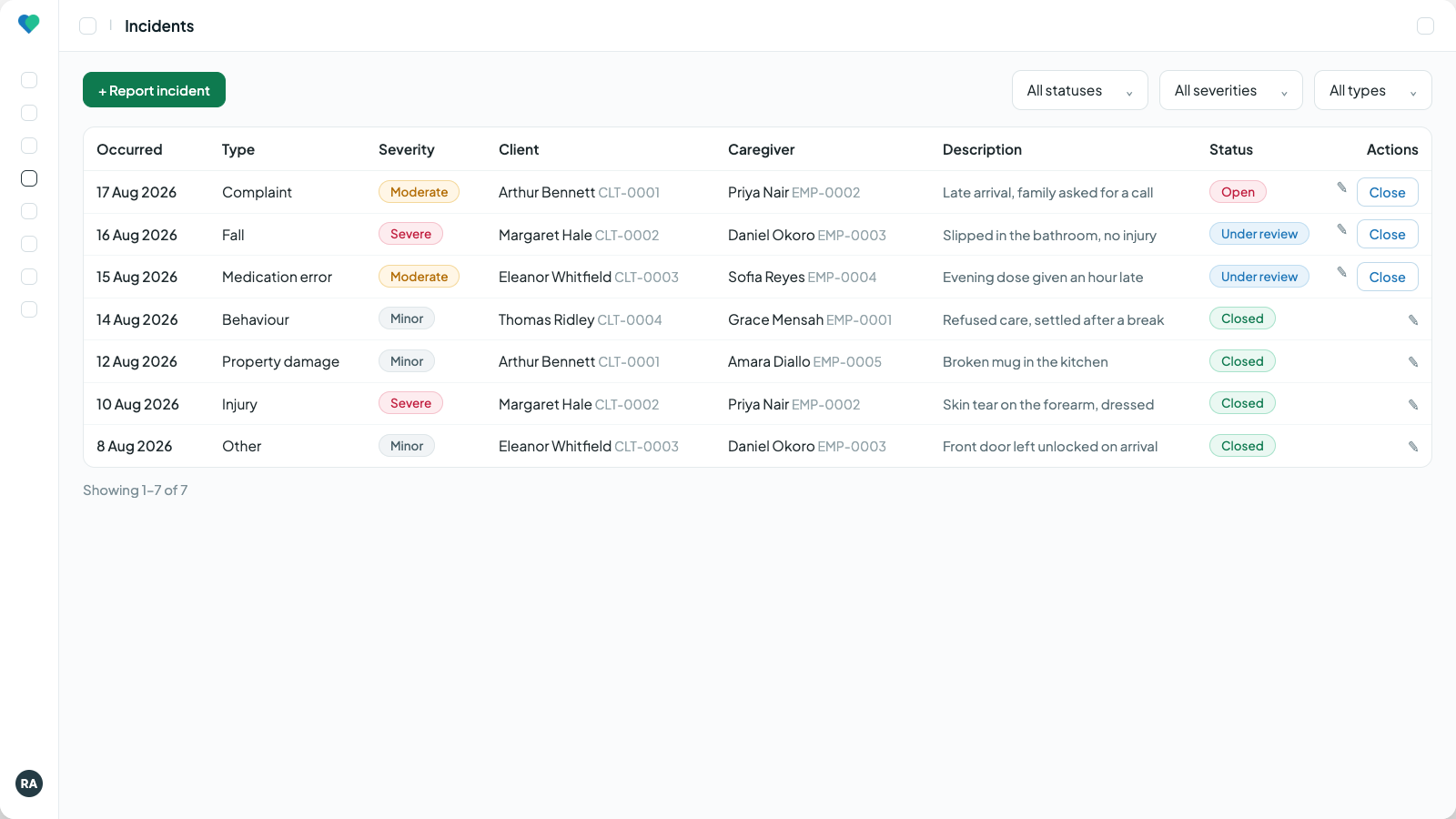
An incident and its trail: what happened, who was told, what was done. Click to enlarge.
The workflow
Open, under review, closed, preserved.
Open
The incident is logged as close to the event as possible, with the facts as known. An open incident is a visible piece of work, not a form in a drawer.
Under review
A coordinator works the incident: notifications made and marked, the action taken recorded, the severity confirmed or corrected as the picture completes.
Closed, read-only
A closed incident cannot be edited by anyone. The record of a hard day stays exactly what it was, ready for the insurer, the inspector, or the family meeting months later.
Incidents are the human half of the safety net. The automatic half, missed visits and late clock-outs caught by the sweep, lives on the alerts page, and the credentials that prevent incidents live on compliance and records.
Common incident questions.
Falls, injuries, medication errors, complaints, property incidents, and behaviour incidents, each with a severity from minor to critical, linked to the client and caregiver involved.
What happened and how severe it was, who was notified, family, physician, or authority, the action taken, and the client and caregiver involved, all on one record that moves through an open, under review, closed workflow.
It becomes read-only. The record of what happened, who was told, and what was done is preserved exactly as it was closed, ready for any later question from a family, an insurer, or an inspector.
No. The family portal is deliberately privacy-scoped to the care schedule and delivered care. Incident records are internal; notifying the family is a decision the agency makes and records on the incident, not an automatic feed.
The hard days deserve the best records.
Start your 30-day free trialNo credit card to start · Cancel anytime