What you actually need
Most agencies need almost nothing.
Caregivers use their own phones
If your caregivers clock in with the Carelyst app, their own phones do everything, iPhone and Android alike, and nothing on this page applies to you. The only hardware worth a look is the ten-cent tap sticker at each client's home, which has its own page.
Sites running the attendance kiosk
Only kiosk sites need equipment: one shared Android phone, one fingerprint scanner, and a pack of staff cards for each office or van. Caregivers' personal phones are never part of the kiosk.
The kiosk phone
The kiosk runs on one shared Android phone per site: it shows the clock, reads the cards, and talks to the scanner. It is the kiosk's phone, not anyone's personal one, and most agencies start with a spare from a drawer.
Typically $0 with a spare phone, or under $200 CAD new.

The fingerprint scanner
A SecuGen Hamster Pro 20, whose sensor is certified under the FBI's PIV image-quality standard. It plugs into the phone's charging port and needs no batteries, no charger, and no licence fees.
About $80 CAD each, and less on a bulk order.

Staff tap cards
Ordinary tap cards identify staff at the kiosk, for anyone who prefers a card over a fingerprint. Each card belongs to exactly one person, enforced by the kiosk itself, and cards go on lanyards or print as photo ID.
About 30 cents per card when bought in packs.
What these cards actually are
The same tap technology as a contactless bank card.
A staff card is a normal plastic card, the same size and thickness as a bank card. Inside is a tiny chip and antenna, powered by the tap itself: no battery, nothing to charge, nothing to wear out. It is the same technology a contactless bank card uses for tap-to-pay, and the same kind of card many cities issue as a transit pass.
Cards print like any plastic card, so many agencies design them as caregiver photo ID: one badge that introduces the caregiver at a client's door and clocks them in at the kiosk.
The same chip also comes as a small adhesive sticker, which Carelyst uses for something different: home tags that caregivers tap at a client's door with their own phones. That story has its own page.
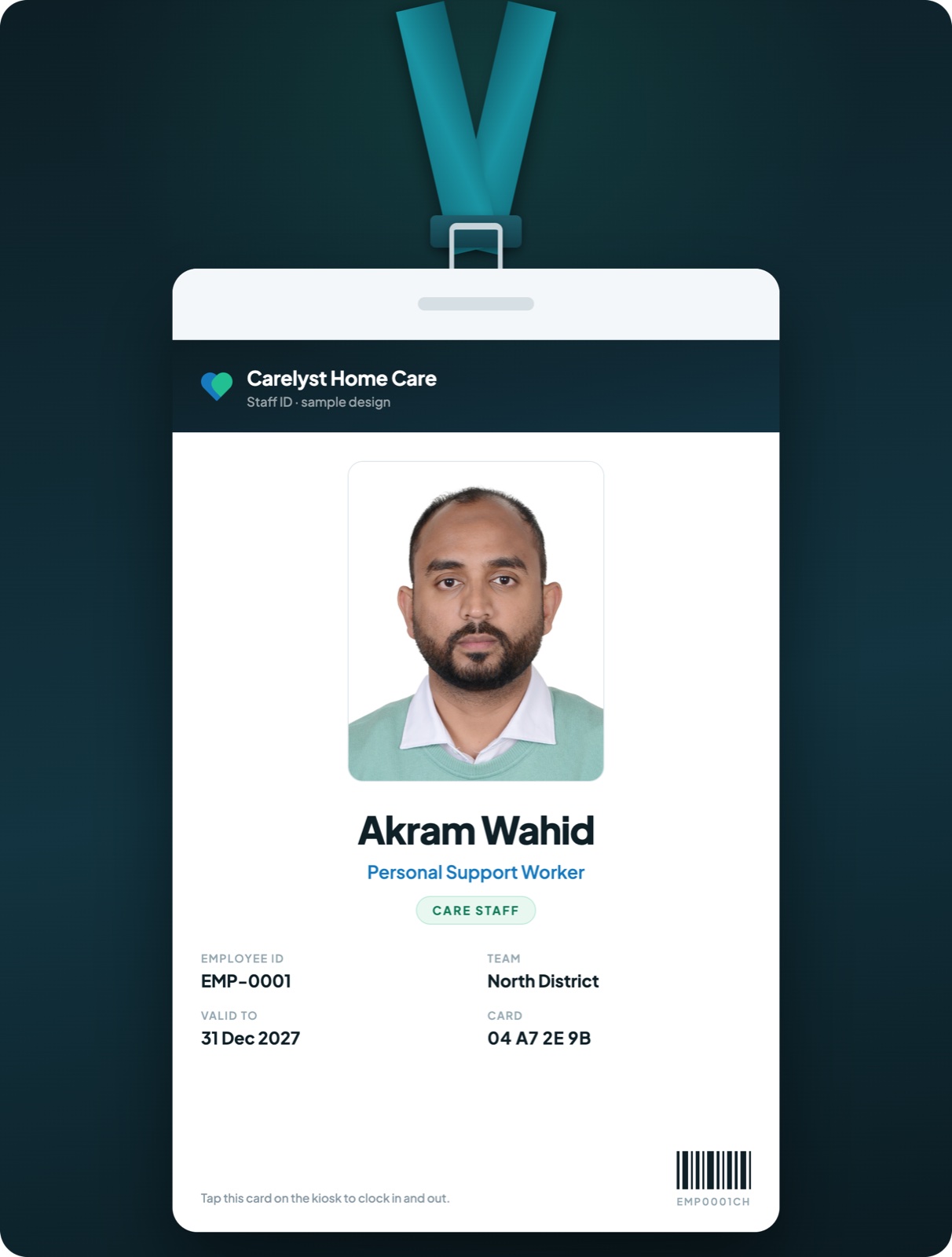
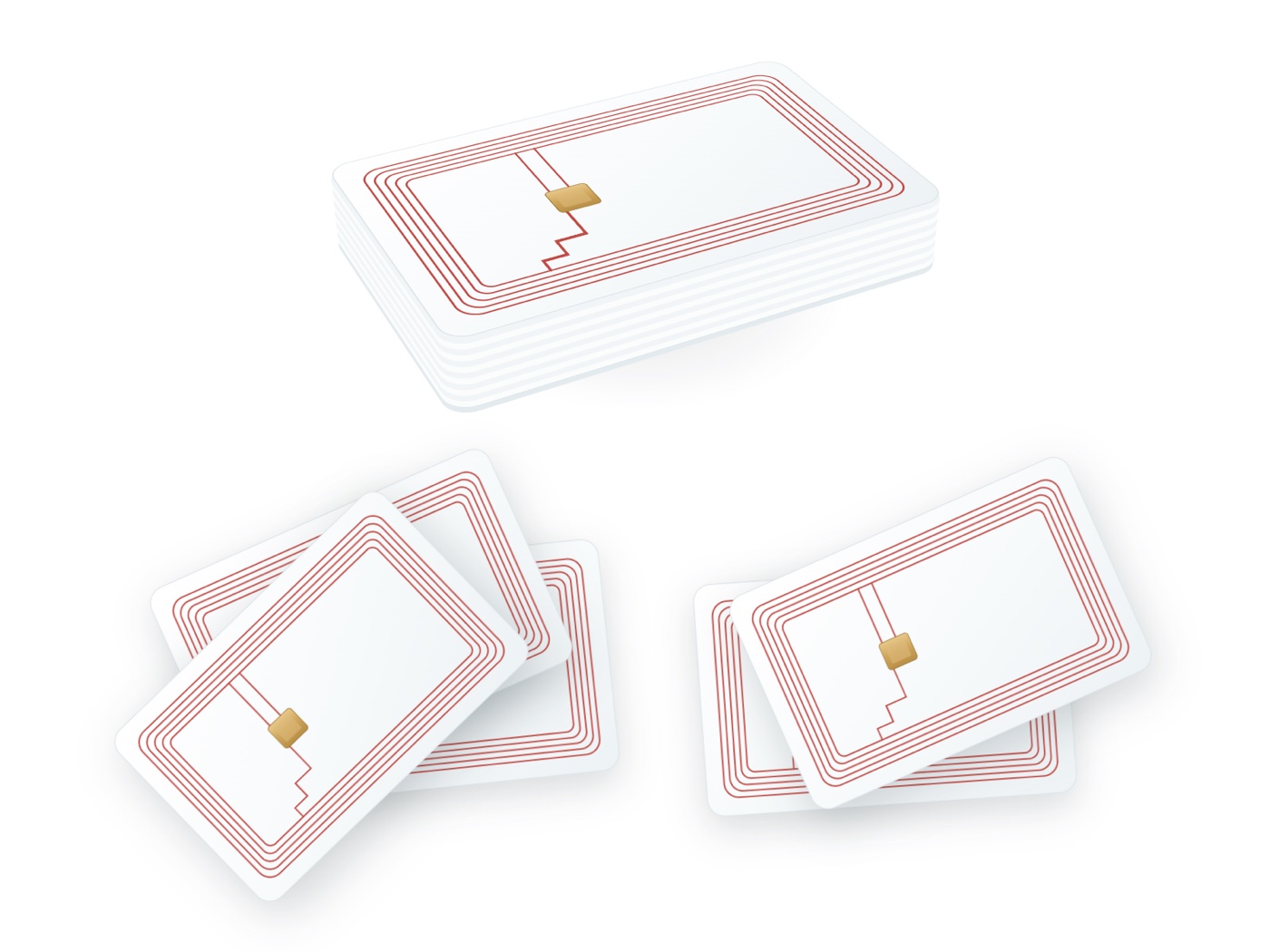
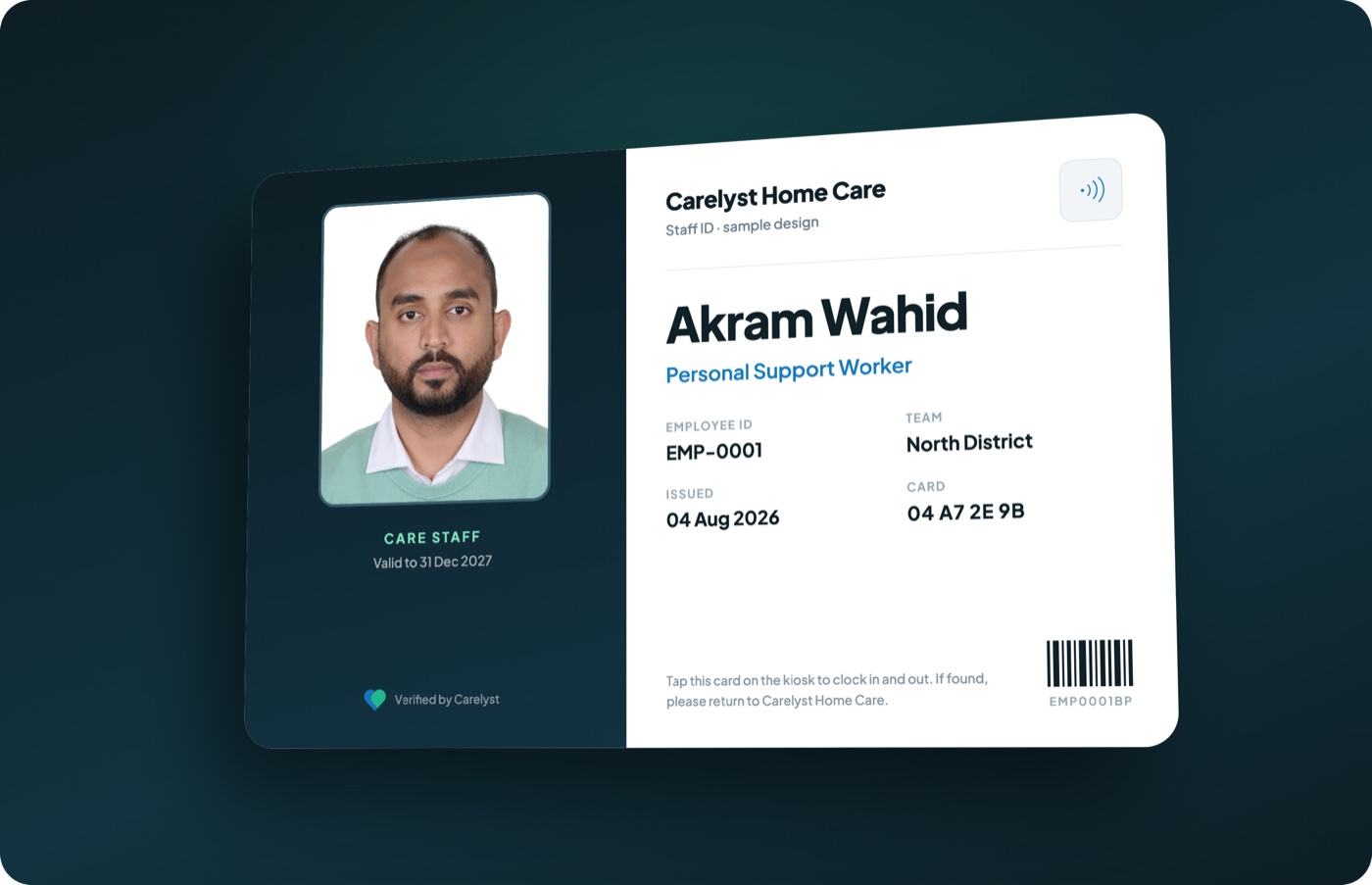
The bare cards, and a sample staff ID design: on a lanyard, the badge is also the clock-in credential.
What a site costs
Less than a hundred dollars, if a drawer holds a spare phone.
Equipping the office means one phone, one scanner at about $80, and a pack of cards for a few dollars. Each van adds one more phone and scanner. There is nothing to install on a wall, no wiring, and nothing that needs a technician.
These are typical street prices from public marketplaces, not ours: Carelyst does not sell hardware or take a margin on it. Prices move around, so treat them as estimates.
A typical office kiosk
Estimated street prices in Canadian dollars. One kiosk serves every caregiver at the site.
Where to buy
Write to us before you order.
Scanners come from SecuGen and its resellers; tap cards are sold by every large online marketplace for a few dollars a pack. We have tested specific phones, scanners, and cards with Carelyst, and we are happy to share the exact shopping list, quote a bulk order of scanners, or arrange the whole order for you.
Or write directly to hello@carelyst.ca
Common hardware questions.
Almost all of the common inexpensive ones do. The kiosk reads a card's unique identity and ties it to one staff member, so there is nothing special to buy. Write to us before ordering and we will point you at the exact packs we tested.
No. One phone and one scanner serve a whole site: the office has one, and each van carries one. Caregivers share the device; their fingerprint or card is what identifies them.
Swap in any other Android phone and pair it with a one-time code; it takes over immediately. Punch history is never tied to a particular handset, and a missing phone can be revoked in the back office, which signs it out at its next contact with the server.
The software is the free part to try.
Start your 30-day free trialNo credit card to start · Read how the kiosk works