What the sweep watches
Five ways a schedule goes wrong. All watched.
The sweep runs in your agency's own timezone and checks every shift against reality. Each finding lands as an alert the moment its condition is met.
Missed shifts
Nobody came and the grace window has passed. The grace period is yours to configure, so a caregiver running five minutes behind is not an emergency.
Missing clock-in
The shift is assigned, it has started, and there is no visit. This is the critical one, and it surfaces while there is still time to act.
Unassigned and coming up
A shift starting within 24 hours with nobody assigned raises its hand before it becomes tomorrow morning's crisis.
Running late and never closed
A visit running past its planned end, and a visit that never clocked out at all, each raise their own alert. Both are overnight-aware, so a shift ending near midnight is not flagged while the caregiver is still punching out.
Double-bookings
Conflict alerts back up the live checks on the schedule, so a double-booking that slips past one net is caught by the other.
Self-healing alerts
Only what still needs a human.
Most alert systems drown coordinators in noise until they stop reading. Carelyst's alerts resolve themselves: the clock-in that answers a missing-clock-in alert clears it, and a late clock-out clears the running-late ones. What remains on screen is, by definition, what nobody has answered yet.
One problem is one alert. Findings are deduplicated per shift and per type, the alerts screen carries an acknowledge and resolve workflow, and the dashboard counts what is still open, so the day starts with the truth instead of a backlog.
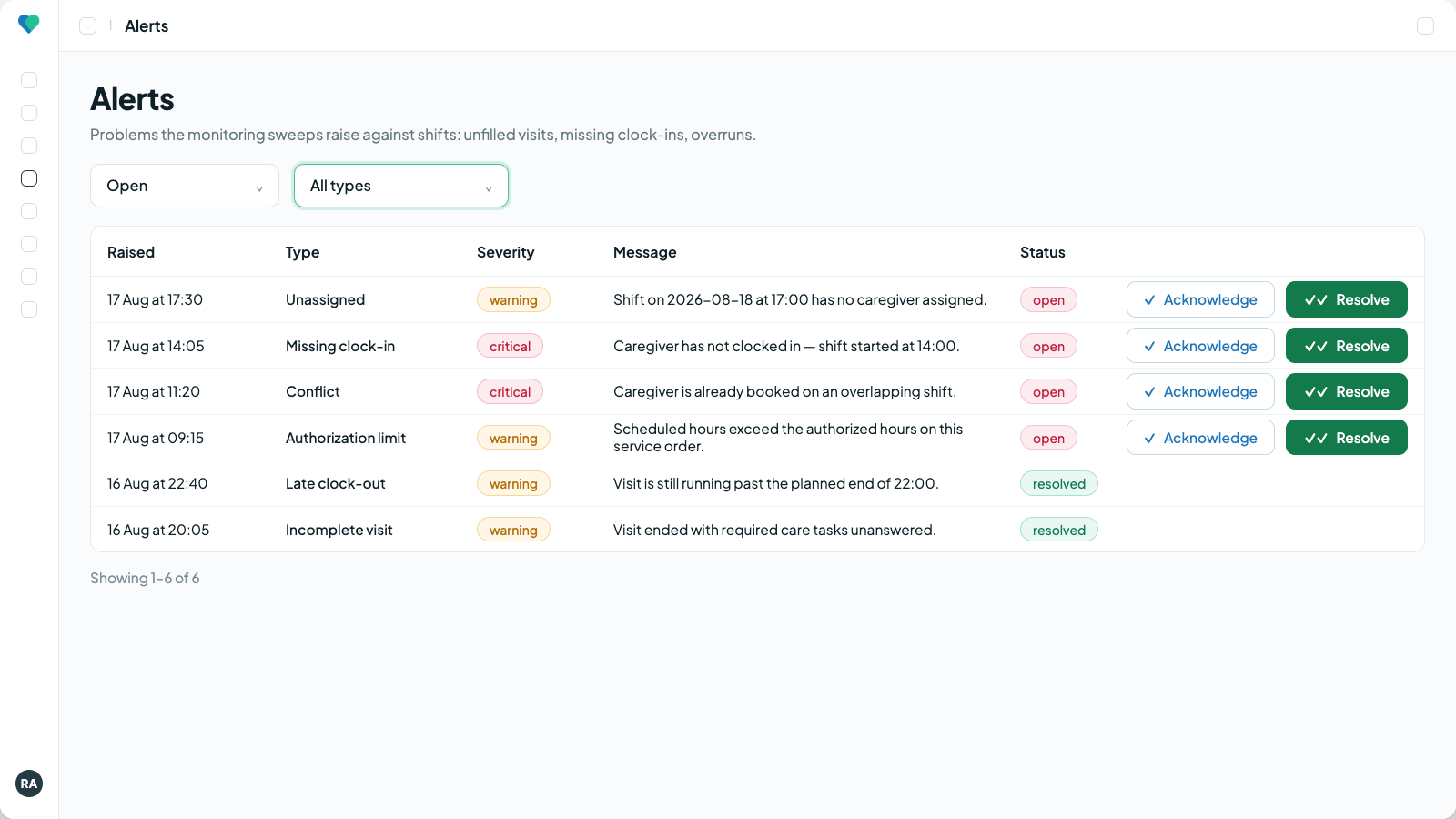
The alerts screen: what still needs a human, and nothing else. Click to enlarge.
Why it matters
The difference between minutes and hours is the whole point.
A missed visit discovered at 9:15 AM is a phone call and a replacement caregiver. The same visit discovered when the family calls that evening is an incident, an apology, and a client wondering whether anyone is watching. The sweep exists so your agency is always the first to know, and the verification engine exists so what did happen is proven. Together they close both halves of the question every family quietly asks.
Common questions about alerts.
The sweep runs every 15 minutes, in the agency's own timezone. A shift that passes its grace window with nobody there raises an alert on that cycle, so the office knows within minutes, not at the end of the day.
The alert clears itself. The clock-in that answers a missing-clock-in alert resolves it, and a late clock-out clears the running-late alerts. Coordinators only ever see alerts that still need a human.
No. The monitoring is overnight-aware: a full-day shift ending near midnight is not flagged as incomplete while the caregiver is still punching out, because the checks carry real slack past the planned end.
No. Alerts are deduplicated per shift and per type, so one problem is one alert. The alerts screen carries an acknowledge and resolve workflow, and the dashboard counts what is still open.
Be the first to know, starting this week.
Start your 30-day free trialNo credit card to start · Cancel anytime